

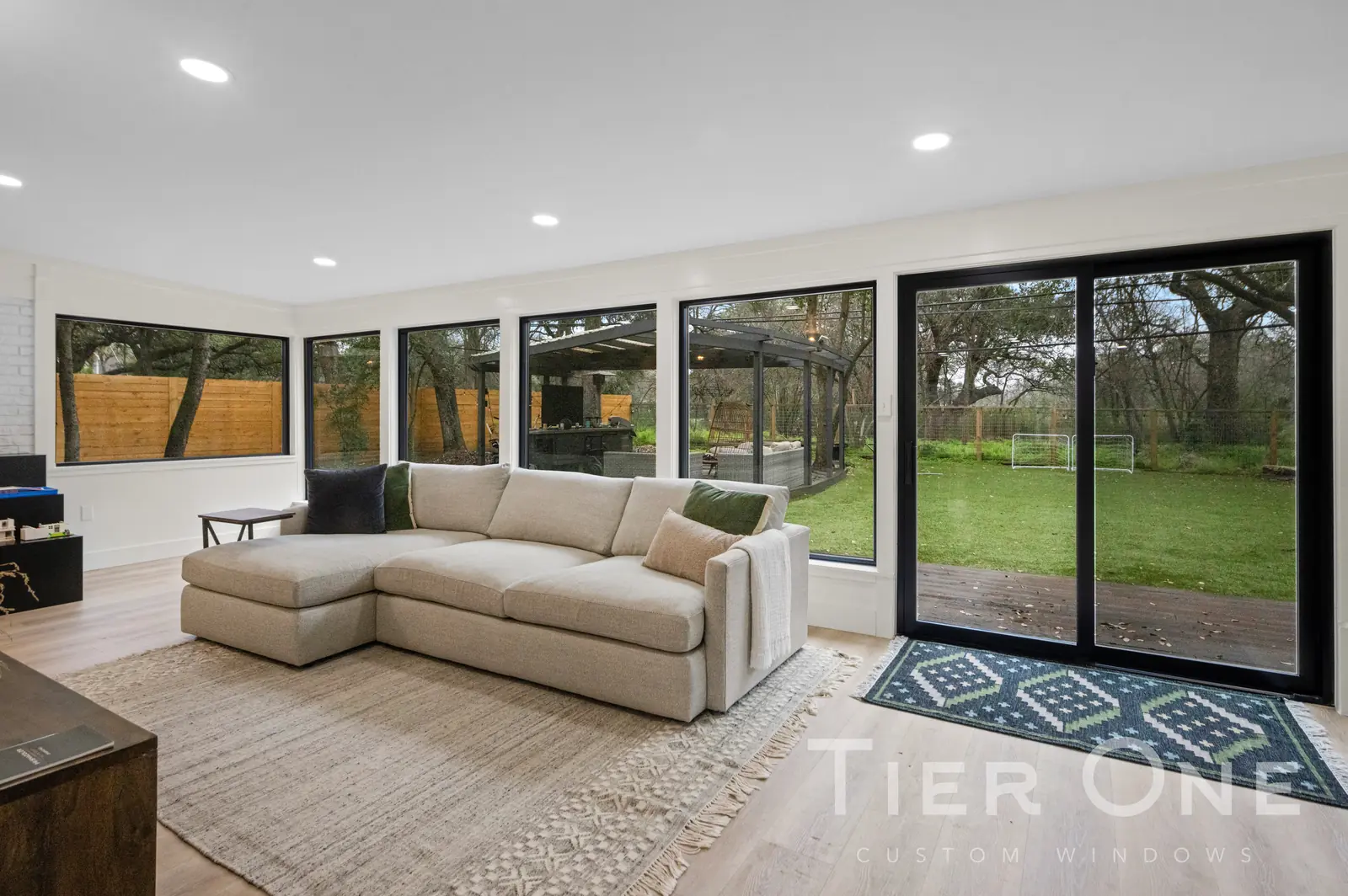
There is no single best window material, and the right answer is set by how long you intend to own the house, how much maintenance you will actually do, and what the opening has to look like. Fiberglass lasts the longest, vinyl costs the least, wood looks the best and asks the most of you, and aluminum does things the others cannot at large sizes.
Material also decides how the window will eventually fail, which is the part most comparisons leave out.
How long does each window material last?
Pella, whose products we install as a Pella Certified Contractor, puts typical window lifespan at 15 to 50 years depending on material, and breaks it down as vinyl at 20 to 40 years, fiberglass at up to 50 years, wood at 30 or more years with proper maintenance, and aluminum at 15 to 30 years.
Those ranges are wide for a reason. Installation quality and climate move a window within its range more than the brand does, and Central Texas heat is harder on sealed units and on vinyl than a milder climate is.
Which window material is most energy efficient?
Frame material influences energy performance, but the glazing package decides most of it. What gets measured is the whole assembly: the EPA's NFRC label reports U-factor, which measures the rate of heat transfer with values generally between 0.25 and 1.25, and Solar Heat Gain Coefficient, which measures the fraction of solar energy transmitted on a 0 to 1 scale. Lower is better on both in a climate like ours.
For an Austin home, ENERGY STAR certification in the South-Central climate zone requires a U-factor of 0.28 or lower and an SHGC of 0.23 or lower. A vinyl window and a fiberglass window can both hit those numbers with the right glass, and an aluminum window generally needs a thermal break to come close.
Texas code backs this up procedurally. Compliance guidance for Texas homes requires that fenestration U-factor and SHGC be determined from an NFRC label on the product, not from a brochure claim. Ask for the label.
Vinyl windows
Vinyl is the most budget-friendly option and asks almost nothing of the owner. Multi-chambered vinyl frames insulate well, the material does not need painting, and maintenance is essentially wiping them down.
The trade-off is heat and sightlines. Vinyl expands and contracts more than the alternatives, which is a real consideration on large west-facing openings in Central Texas, and vinyl frames are thicker than fiberglass or aluminum for the same glass area, so you see more frame and less view. Colors are also limited, because vinyl is not reliably paintable.
Best for: budget-conscious replacements, rental property, and homes where the windows are functional rather than architectural.
Wood windows
Wood gives design flexibility and a look nothing else reproduces, particularly on older homes and on high-end new builds where the interior is meant to read as warm rather than industrial. Wood can be milled to profiles the other materials cannot match.
Wood also asks for upkeep, and that is the honest cost. Pella puts wood at 30-plus years with proper maintenance, and the qualifier is doing the work. Most wood windows we replace failed at the paint and then the sill, not in the glass. Aluminum-clad wood removes most of the exterior maintenance while keeping the interior, which is the version most Austin clients choose.
Best for: historic and high-design homes, and owners who want wood interiors and will accept clad exteriors.
Fiberglass windows
Fiberglass is the longest-lasting of the four, at up to 50 years by Pella's figures, and it is the most dimensionally stable in heat. Fiberglass expands at close to the same rate as the glass it holds, which keeps the seal under less stress through a Texas summer than a frame that moves more than its glazing does.
It is also powder-coated rather than painted, so the finish does not need redoing, and the frames are slimmer than vinyl for the same opening. The trade-off is cost, which sits above vinyl.
Best for: owners staying in the home long-term, large or sun-exposed openings, and anyone who would rather buy once.
Aluminum windows
Aluminum is the material for openings the others cannot do. Thermally broken, extruded aluminum carries monumental sizes on narrow profiles, which is why large-format and glass-wall systems are aluminum rather than vinyl or wood.
Its weakness is conduction. Aluminum moves heat readily, so an aluminum window without a proper thermal break performs poorly in our climate, and Pella puts aluminum lifespan at 15 to 30 years, the shortest of the four. Specified properly, in the right application, none of that disqualifies it.
Best for: modern architecture, multi-slide and pivot systems, commercial work, and any opening where the view matters more than the frame.
Which should you choose?
Choose fiberglass if you are staying put and the openings take sun. Choose vinyl if budget leads and the openings are modest. Choose clad wood if the interior look is the point. Choose aluminum when the opening is large enough that nothing else will carry it.
The material conversation is also where a brand-agnostic installer is worth more than a single-brand one. We work across Pella, Marvin, Andersen, Western Window Systems and Panda, which means we have no reason to steer you to a material because it is the only one we sell. If you want a straight recommendation for your specific openings, we will give you one on a free on-site consultation, anywhere from Austin to Georgetown to Horseshoe Bay. Call (512) 615-8629 or request a quote.
You can see the four materials at work across different projects in our portfolio, and read more about whole-home window replacement if you are replacing all of them at once.