

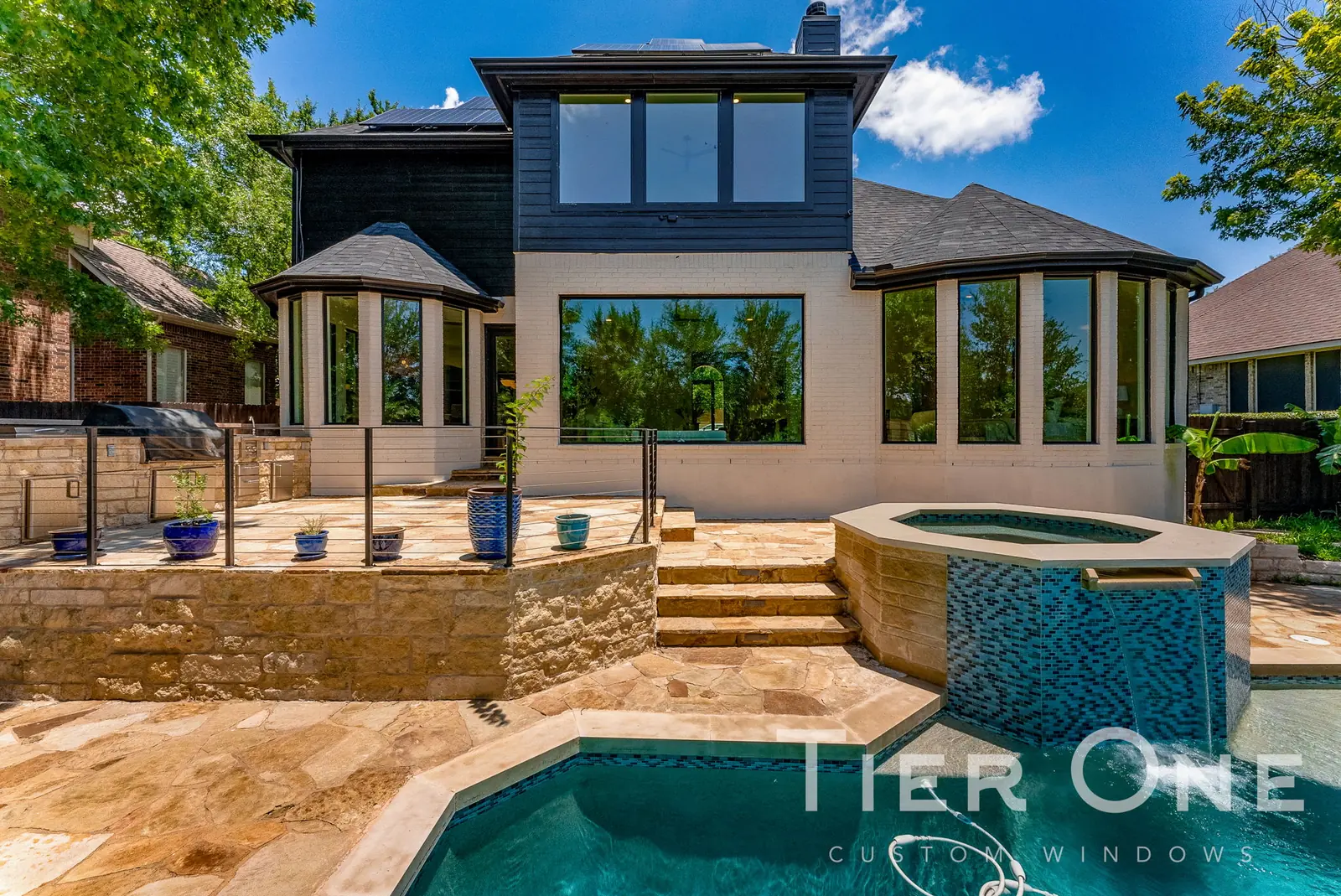
Floor-to-ceiling windows are usually worth it when the view earns the glass and the specification matches the orientation, and usually a mistake when a large west-facing wall of glass gets specified like an ordinary window. The glass itself is rarely the deciding factor. In Central Texas the deciding factors are solar orientation, the safety glazing the code requires at that size, and whether the opening can carry the load.
This is a question we get on almost every hill country remodel, and the honest answer depends on three things that have nothing to do with the window catalog.
Do floor-to-ceiling windows add value to a home?
Large-format glass reliably changes how a room reads, and that is where its value sits. A wall of glass makes a room feel larger, pulls daylight deeper into the floor plan, and turns a view into part of the architecture. On a lot with a view worth framing, that is a genuine design upgrade.
The value case gets weaker when there is no view. Floor-to-ceiling glass facing a fence line costs considerably more than a well-placed picture window and delivers less. Glass is expensive per square foot, and square footage of glass is not itself the amenity.
How much heat do floor-to-ceiling windows let in?
That depends almost entirely on the Solar Heat Gain Coefficient of the glazing and the direction the wall faces. The EPA explains that SHGC measures the fraction of solar energy a window transmits, on a scale of 0 to 1, with values typically ranging from 0.25 to 0.80, and the lower the number the less solar heat comes through.
Austin's own energy code treats east and west glass as a special case. Under Article 12 of the City of Austin Energy Code, section R402.6, the SHGC of fenestration within 45 degrees of east or west may be no greater than 0.25 unless a protection factor multiplier is applied. That rule exists because a west-facing wall of glass in Central Texas takes direct afternoon sun in the hottest part of the day.
For reference, ENERGY STAR certification in the South-Central climate zone that Austin sits in requires a U-factor of 0.28 or lower and an SHGC of 0.23 or lower for windows, under the Version 7.0 specification that took effect in October 2023. A large glass wall specified to those numbers behaves very differently from one that is not.
Does floor-to-ceiling glass have to be tempered?
At that size, generally yes. The 2021 International Residential Code, section R308.4.3, treats glazing in a window as a hazardous location requiring safety glazing when the exposed pane exceeds 9 square feet, the bottom edge sits less than 18 inches above the floor, the top edge sits more than 36 inches above the floor, and a walking surface is within 36 inches horizontally. A floor-to-ceiling window meets all four conditions by definition.
Federal rules sit underneath that. The Consumer Product Safety Commission's 16 CFR Part 1201 sets performance requirements for glazing used in architectural products including doors and sliding glass doors. None of this is an obstacle, and all of it is a cost line that belongs in the quote rather than in a change order later.
What has to happen structurally?
A floor-to-ceiling opening usually removes wall that was doing work. Widening or heightening an opening means a new header sized for the span and the load above it, and that is a structural change rather than a window swap. On a remodel it also means the framing, drywall, paint and exterior finish around the opening all get disturbed.
This is the part homeowners underestimate most often. The window is one line item, and the reframing, drywall, paint and masonry work around it is another. We handle both in-house, which is less about convenience than about nobody being able to blame the other trade when the opening does not line up.
If you are weighing a large-glass opening on an Austin remodel, a free on-site consultation is the fastest way to find out whether the wall can take it before anyone prices glass. You can reach us at (512) 615-8629.
When does a moving glass wall make more sense?
Often, if the goal is indoor-outdoor living rather than a view through fixed glass. A fixed floor-to-ceiling window gives light and sightlines. A multi-slide or pivot system gives the same sightlines and opens.
Panda, one of the manufacturers we work with, has been building large-format systems since 1991 and reaches a 24 foot pivot height on its Voyage line. Specifications at that scale are an architectural decision made early, not a product picked at the end, which is why these conversations work better before framing is finalized.
So are they a smart investment?
Floor-to-ceiling windows are a smart investment when three conditions hold at once: there is a view or a daylight problem worth solving, the orientation is north or the glazing is specified for east and west exposure, and the structure can carry the opening. When any one of those is missing, the money usually does more in a smaller, better-specified opening.
Tier One Custom Windows is an Austin-based, family-owned window and door specialist with 30-plus years of combined team experience and Pella Certified Contractor status. If you are considering large-format glass anywhere from Westlake to Marble Falls, we will tell you plainly whether the wall is a good candidate before we quote it. See our portfolio for projects where large openings carried the design, or get in touch for a free consultation.