

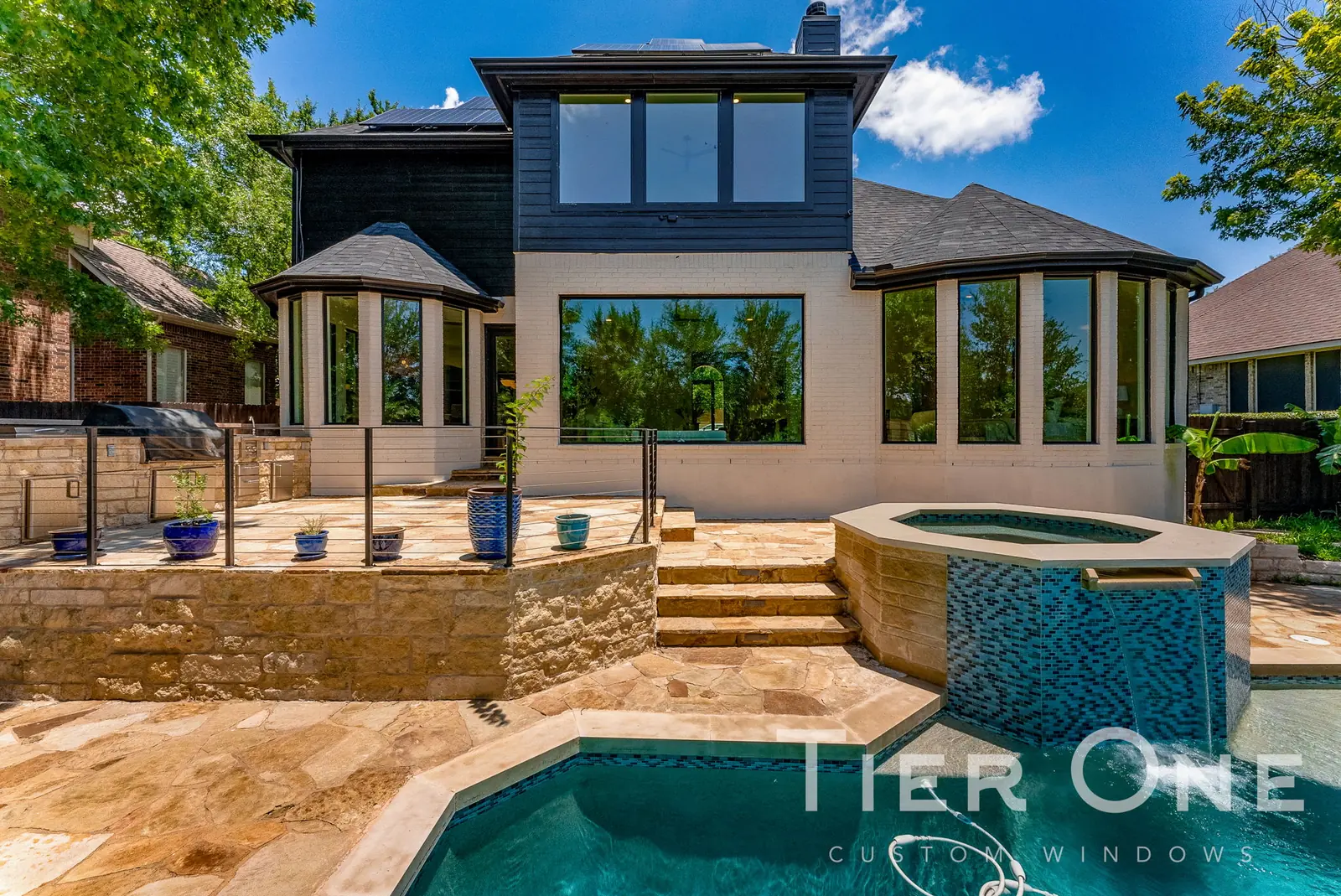
West-facing windows are the hardest-working glass in a Central Texas house, because they take direct sun during the hottest hours of the day, and the single specification that controls how much of that heat gets inside is Solar Heat Gain Coefficient. Austin's energy code treats east and west glass as a distinct problem and regulates it separately from the rest of the house.
If one room in your house is unusable from three in the afternoon until sunset, this is almost always why.
Does Austin's building code treat west-facing windows differently?
Yes, and explicitly. Article 12 of the City of Austin Energy Code, in section R402.6, states that the SHGC of fenestration within 45 degrees of east or west shall be no greater than 0.25, unless the protection factor multiplier in Table R402.6 is applied.
That is a stricter number than the code's general requirement. Austin's prescriptive values for Climate Zone 2, which Austin sits in, are a U-factor of 0.35 and an SHGC of 0.28 for new construction. East and west glass gets pulled to 0.25 because orientation changes the physics, not because the glass is different.
The exception matters too. The protection factor multiplier allows a higher SHGC where the glass is shaded, which is the code recognizing that an overhang, a porch or a deep reveal does real work.
What is SHGC, and what number should west-facing glass have?
SHGC measures the fraction of solar energy a window transmits. The EPA describes it on a scale of 0 to 1, with values typically ranging from 0.25 to 0.80, and the lower the number the less solar heat the window lets through.
For west-facing glass in Austin, 0.25 is the code ceiling and lower is better. ENERGY STAR certification in the South-Central climate zone that Austin belongs to requires an SHGC of 0.23 or lower, along with a U-factor of 0.28 or lower, under the Version 7.0 specification that took effect in October 2023. Specifying to the ENERGY STAR number rather than the code minimum gets you under the ceiling with margin.
The US Department of Energy's guidance for warmer climates says the same thing in plainer terms: east- and west-facing windows should be specified for low SHGC and low U-factor, or shaded.
Why is west worse than south?
Because of sun angle and timing together. South-facing glass takes sun when it is high in the sky, which means an overhang can shade it effectively and the heat arrives earlier in the day. West-facing glass takes sun low on the horizon in the late afternoon, when the outdoor temperature is already at its daily peak and the sun comes in nearly horizontally, under most overhangs.
That combination is why the west side of a Central Texas house stays hot after sunset. The heat arrives at the worst possible time and the usual shading strategies do not intercept it.
Can you fix west-facing heat without replacing the windows?
Sometimes, and it is worth trying first. Exterior shading is the most effective non-replacement option, because stopping sun before it reaches the glass beats managing it afterwards. Awnings, exterior screens, a planted shade tree and deep reveals all count, and Austin's own code acknowledges shading through its protection factor multiplier.
Interior treatments help with glare and help far less with heat. Film is a middle option that can lower SHGC on existing glass, with the caveat that applying film to a sealed insulated unit can affect its warranty, so check before anyone applies anything.
Replacement becomes the right answer when the existing glass has no low-emissivity coating at all, when the sealed units have already failed, or when the windows are old enough that you are replacing them for other reasons anyway. At that point specifying the west elevation properly costs very little extra against the job.
Which rooms should you prioritize?
Prioritize the west elevation first, then south, then east, then north. Inside the west elevation, prioritize rooms you use in the late afternoon and evening, because that is when the problem shows up: west-facing living rooms, kitchens and primary bedrooms.
Most Central Texas homes we assess do not need every window replaced at once. Treating the west side correctly and leaving the north elevation for later is frequently the better use of the same budget, and it is the kind of recommendation worth getting before anyone writes a whole-home quote.
Get your west elevation specified properly
If a west-facing room in your house is uncomfortable every afternoon, the fix starts with reading what is currently on the glass and what the orientation actually demands. We will do that on a free on-site consultation, and we will tell you if shading solves it more cheaply than glass.
Tier One Custom Windows is an Austin-based, family-owned specialist with 30-plus years of combined team experience, working from Austin out through Cedar Park, Georgetown, Lakeway, Leander, Round Rock and West Lake Hills. Call (512) 615-8629 or book a free consultation.
For whole-house projects, our whole-home window replacement page covers how we sequence a full replacement by elevation.